The Connection Gap: Why So Many Americans Feel Alone and How to Change It
By Jazmine Davis | Willow Oak Community Behavioral Health Center
Friendship, confidence, communication, and personal growth aren’t gifts reserved for a lucky few. They’re skills we can learn, strengthen, and develop with support.
Imagine waking up in the morning, going to work, coming home, scrolling through social media, and going to bed.
You spoke to people throughout the day. You answered emails. You smiled at a cashier. Maybe you even exchanged a few messages with friends online.
But when something wonderful happens, you don’t know who to call.
When something goes wrong, you don’t have anyone you feel comfortable confiding in.
And when the weekend arrives, you find yourself wishing someone would invite you somewhere.
You’re surrounded by people, yet you feel completely alone.
For millions of Americans, this isn’t an occasional experience. It’s part of everyday life.
But here’s something I want you to consider:
What if the problem isn’t that you’re incapable of building meaningful relationships? What if you simply haven’t been taught the skills that make connection easier?
And what if the same applies to other areas of your life—making friends, communicating confidently, applying for jobs, or preparing for interviews?
Sometimes, the difference between where we are and where we want to be isn’t luck.
It’s learning.
What If Connection Is a Skill You Haven’t Learned Yet?
In my work in community engagement, communications, and crisis support, I’ve come to appreciate just how deeply people need meaningful connections.
Not just someone to talk to, but someone who understands them. Someone they can call when life gets difficult. Someone who celebrates their accomplishments and reminds them they matter.
Yet for many people, those relationships are missing.
Imagine going through your entire day surrounded by people, yet feeling like nobody truly knows you.
You go to work, exchange pleasantries with coworkers, scroll through social media, and return home. You may have hundreds of contacts in your phone, but when something exciting happens—or something heartbreaking—you struggle to think of someone you can call.
You want meaningful friendships. You want to feel confident in social settings. You want opportunities to grow personally and professionally.
But somewhere along the way, you’ve convinced yourself that these things are simply easier for other people.
Maybe you’ve thought:
“Why does everyone else seem to make friends so easily?”
“Why can’t I walk into a job interview without becoming overwhelmed?”
“Why do I struggle with conversations that seem so natural to everyone else?”
Here’s something I want you to consider:
What if you aren’t lacking potential? What if you’re simply missing information, practice, or guidance?
We teach people how to drive, prepare for exams, and manage their finances. We understand that learning these skills requires instruction.
But how often do we intentionally teach someone how to build a friendship, communicate their needs, maintain healthy relationships, prepare for a job interview, or develop emotional confidence?
These are important life skills, yet we often expect people to figure them out on their own.
And when they struggle, they sometimes blame themselves.
I believe there’s tremendous value in having the humility to say, “I don’t know how to do this yet, but I’m willing to learn.”
That statement isn’t an admission of failure. It’s the beginning of growth.
Through my work supporting individuals in crisis, I’ve also seen the importance of having someone willing to listen, provide guidance, and help identify the next step forward.
We don’t always need someone to solve our problems for us. Sometimes, we need someone with the right training and experience to help us develop the tools to navigate those problems ourselves.
That’s one of the reasons I believe behavioral health support is so valuable.
It’s not only about getting through difficult moments. It can also be about learning to communicate, strengthening relationships, understanding emotions, and building confidence.
And when we look at the growing number of Americans who report feeling lonely or disconnected, it’s clear that conversations about connection and personal development are needed.
The Loneliness Epidemic: What the Numbers Tell Us
We live in a time when connecting with people has never seemed easier.
We can send messages instantly, join online communities, follow hundreds of people, and communicate across continents.
Yet many Americans still feel emotionally disconnected.
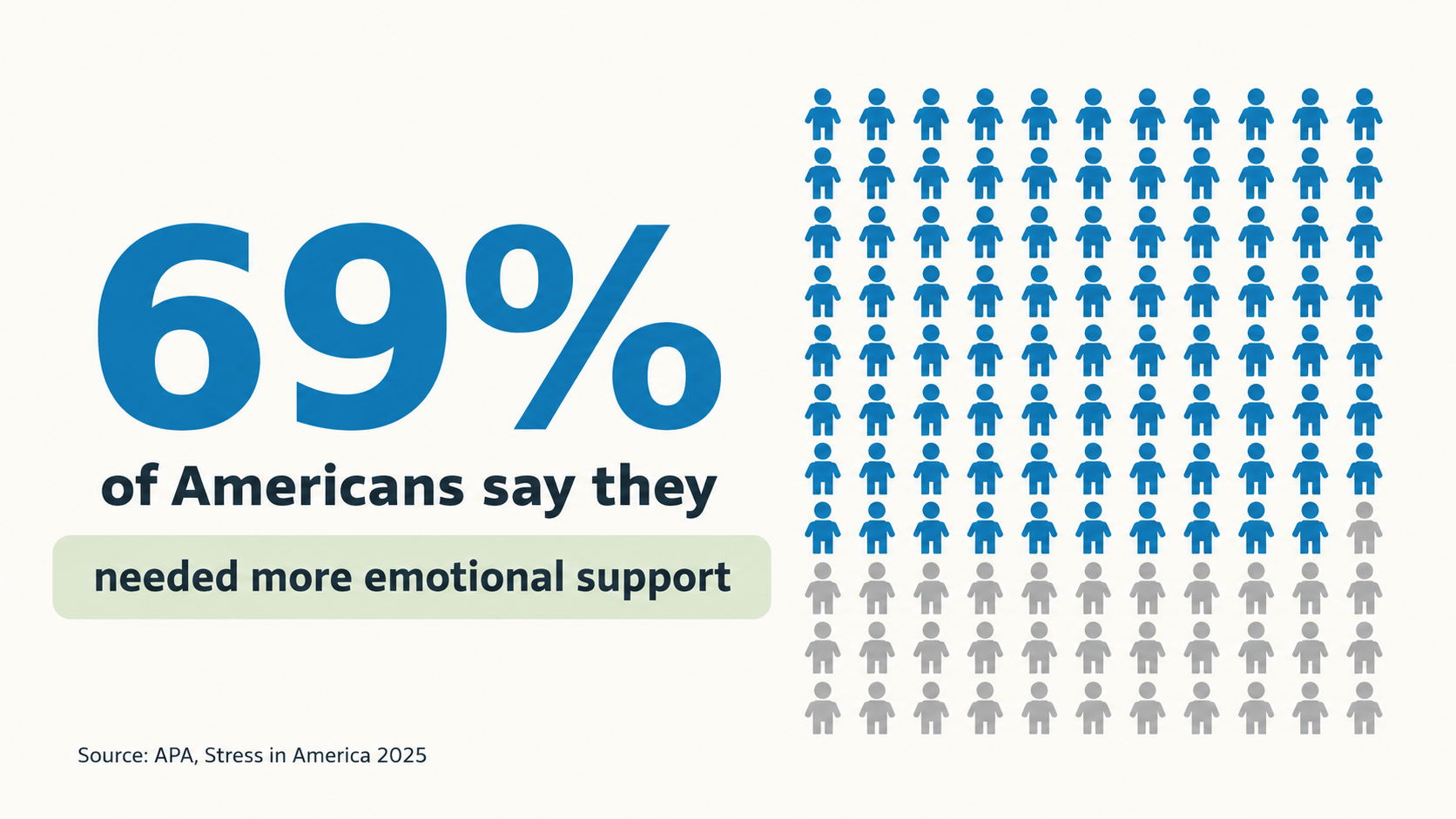
According to the American Psychological Association’s 2025 Stress in America survey, conducted among 3,199 U.S. adults:
- 54% reported feeling isolated from others often or some of the time.
- 50% reported lacking companionship often or some of the time.
- 50% reported feeling left out often or some of the time.
- 69% said they needed more emotional support in the previous year than they actually received.
Think about that.
More than half of surveyed adults experienced some degree of isolation, while nearly seven in ten felt they weren’t receiving enough emotional support.
Another study, the American Psychiatric Association’s 2025 Healthy Minds Monthly Poll, found that 33% of adults reported feeling lonely at least once a week.
These findings don’t mean that half of Americans have no friends or meaningful relationships. They reveal something more complicated: many people have relationships but still feel that an important emotional need isn’t being met.
We can be socially active without feeling understood.
We can have acquaintances without having close friends.
We can be surrounded by family and still struggle to express what’s happening inside.
And sometimes, we may not know how to change that.
Being Around People Is Not the Same as Feeling Connected
There’s a difference between social contact and meaningful connection.
Social contact happens when we interact with others.
Meaningful connection develops when we feel accepted, understood, valued, and emotionally safe.
Consider two people.
The first has hundreds of social media followers and attends several gatherings every month but feels unable to share personal struggles with anyone.
The second has three close friends who regularly check on one another, celebrate milestones, and provide emotional support.
The first person may have more social interactions, but the second may experience a deeper sense of connection.
The quality of our relationships matters.
In fact, the U.S. Surgeon General’s 2023 advisory on loneliness and isolation identified social connection as an important contributor to physical health, emotional well-being, and community resilience.
The encouraging part is that meaningful relationships don’t require popularity, perfection, or an outgoing personality.
They require opportunities, communication, trust, and the willingness to develop relationships over time.
Those are things we can work on.
Let’s Talk About Humility: It’s Okay Not to Know How
There’s something we don’t discuss enough when talking about personal growth.
Humility.
We often associate humility with being modest or admitting when we’re wrong.
But humility also means being willing to acknowledge when we don’t know something—and being open to learning.
Some people naturally seem comfortable starting conversations.
Others walk into job interviews and appear completely confident.
Some individuals make friends wherever they go, while others struggle to move beyond small talk.
It’s easy to look at those people and think:
“Why does this seem so easy for everyone except me?”
But here’s what we need to remember.
People develop skills through different experiences.
Someone who grew up in a home where people openly discussed emotions may have had opportunities to practice communication from an early age.
Someone who participated in clubs, sports, or community organizations may have had repeated opportunities to develop friendships.
Another person may have received job interview coaching, practiced with a mentor, or learned professional communication through previous employment.
What looks effortless may actually be the result of years of practice, encouragement, and instruction.
There is no shame in learning something as an adult that someone else learned as a child.
You aren’t required to know everything.
You are allowed to ask questions.
You are allowed to seek guidance.
And you are allowed to become a beginner.
Making Friends Is a Skill You Can Learn
Let’s say you’re 32 years old.
You’ve moved to a new city, your coworkers already have established friendships, and most weekends you stay home.
You want to meet people, but you don’t know where to begin.
Maybe you worry about saying the wrong thing.
Maybe you struggle to keep conversations going.
Maybe you’ve been rejected before and don’t want to experience that feeling again.
Over time, you stop trying.
You tell yourself you’re simply not a social person.
But what if that conclusion isn’t the whole story?
What if you need guidance, practice, and encouragement?
Practical Ways to Build Friendship Skills
Building meaningful friendships usually involves several smaller skills.
1. Starting conversations
You can practice asking open-ended questions, making appropriate introductions, and finding shared interests.
Instead of worrying about being interesting, try becoming curious about the person you’re speaking with.
2. Keeping conversations going
Good conversations involve listening, responding, and gradually sharing information about yourself.
You don’t have to be the funniest or most entertaining person in the room.
3. Following up
Friendships often grow through repeated interaction.
Sending a message, extending an invitation, or checking in after a conversation helps turn acquaintances into connections.
4. Handling rejection
Not every invitation will be accepted, and not every relationship will develop into a friendship.
Learning how to manage disappointment without interpreting it as personal failure can make socializing less intimidating.
5. Creating opportunities for connection
Community events, volunteer activities, classes, faith communities, and interest-based groups can provide opportunities to meet people with shared interests.
These behaviors can be practiced.
And when anxiety, past experiences, depression, or low self-esteem make them difficult, behavioral health support may help address those barriers.
Behavioral Health Isn’t Just About Getting Through a Crisis
When people hear the words “behavioral health,” they sometimes imagine someone experiencing a severe mental health emergency.
But behavioral health care also helps people address everyday patterns involving thoughts, emotions, behaviors, relationships, and functioning.
You don’t have to reach a breaking point before asking for support.
Perhaps you’re struggling with social anxiety.
Maybe you have difficulty setting boundaries, expressing your needs, or managing disagreements.
You may feel stuck because you lack confidence or because previous experiences have made you afraid to try new things.
Counseling can provide a structured environment to explore these challenges.
Depending on your needs, a behavioral health professional may help you:
- Identify thoughts that contribute to fear or avoidance.
- Practice healthier communication skills.
- Build emotional awareness and coping strategies.
- Develop confidence in social situations.
- Understand patterns in relationships.
- Set realistic, achievable personal goals.
- Work through experiences that interfere with trust or connection.
Support doesn’t mean someone else lives your life for you.
It means you have an opportunity to gain insight, practice new strategies, and make decisions with greater confidence.
You Wouldn’t Take a Test Without Studying. Why Approach Life Without Preparation?
Think about the last time you had an important opportunity.
Maybe it was a job interview.
Maybe it was your first day at a new workplace.
Maybe you were preparing to meet someone new or attend an event where you didn’t know anyone.
Did you feel prepared?
Or did you simply cross your fingers and hope everything would work out?
Hope can be encouraging, but preparation gives us something practical to work with.
Consider someone who has been applying for jobs for months.
They send out applications, occasionally receive an interview invitation, and then become so nervous that they struggle to answer questions.
Afterward, they blame themselves.
“I guess I’m just bad at interviews.”
But interviewing involves learnable skills.
You can practice introducing yourself.
You can prepare examples of your experience.
You can rehearse how to answer common questions.
You can learn how to communicate your strengths and ask thoughtful questions about the position.
A career counselor, employment specialist, workforce development program, or qualified coach can help with these skills.
And if anxiety, depression, difficulty concentrating, or low self-confidence are interfering with your ability to prepare or participate, behavioral health care may help address those underlying challenges.
These supports can complement one another.
You don’t have to cross your fingers and hope for the best when there are trained people who can help you prepare.
The same principle applies to friendships, relationships, communication, and personal development.
How Behavioral Health Can Help Bridge the Connection Gap
Loneliness doesn’t always have a single cause.
Someone may feel isolated after moving to a new community, losing a loved one, ending a relationship, or changing jobs.
Other people may struggle with connection because of social anxiety, depression, trauma, low self-esteem, or difficulty trusting others.
Some simply haven’t had many opportunities to develop close relationships.
That’s why a personalized approach matters.
Individual Therapy: Understanding What’s Holding You Back
Individual counseling provides an opportunity to explore patterns that may interfere with connection.
For example, someone who fears rejection may avoid invitations because they assume others won’t enjoy their company.
A therapist can help that person examine the thought pattern, explore its origins, and practice alternative responses.
The goal isn’t to change someone’s personality.
It’s to help them build skills and develop ways of relating to others that feel healthier and more fulfilling.
Group Therapy: Growing Alongside Others
Group therapy can offer opportunities for shared learning, encouragement, and practicing interpersonal skills in a facilitated setting.
Participants may learn from other people’s experiences, discuss common challenges, and develop greater confidence speaking with others.
For someone who feels isolated, a supportive group setting may also reduce the feeling that they’re facing their struggles alone.
Group therapy isn’t the same as a friendship club, and participation doesn’t guarantee friendships. However, it can create a structured setting for practicing communication and connection.
Case Management: Connecting People to Community Resources
Sometimes the barriers to a fulfilling life extend beyond emotional concerns.
A person may need help identifying housing resources, navigating benefits, locating community programs, or coordinating services.
Case management can help individuals access appropriate resources and address practical obstacles that interfere with stability and well-being.
When those needs are better supported, people may find it easier to pursue personal and social goals.
Five Small Steps Toward a More Connected Life
If you feel lonely or disconnected, you don’t have to change everything overnight.
Start with manageable goals.
1. Identify the Connection You’re Missing
Ask yourself what kind of relationship you want.
Do you need someone to talk to regularly?
Would you like more friends with shared hobbies?
Are you hoping to improve your relationship with family members?
Knowing what you’re seeking can help you make more intentional choices.
2. Choose One Opportunity to Meet People
Consider attending a community activity, volunteering, joining a class, or reconnecting with an acquaintance.
Look for something you genuinely enjoy.
Repeated interactions around shared interests can make conversations feel more natural.
3. Practice One Communication Skill
Choose something specific.
You might practice introducing yourself, asking a follow-up question, listening without interrupting, or inviting someone to coffee.
Small improvements become easier to recognize when you focus on one skill at a time.
4. Ask for Guidance When You Need It
If anxiety, painful experiences, or uncertainty repeatedly prevent you from forming relationships, consider seeking professional support.
You don’t need to wait until loneliness becomes overwhelming.
5. Celebrate Progress, Not Perfection
Perhaps you attended an event even though you felt nervous.
Maybe you reached out to someone you hadn’t spoken with in months.
Maybe you completed your first counseling appointment.
Those are meaningful steps.
Building a fulfilling life is a process, not a competition.
What If the Life You Want Is Something You Can Learn to Build?
I want to return to the idea of humility because I believe it matters.
Sometimes, pride keeps us from asking questions.
We don’t want to admit that we struggle with things other people appear to do naturally.
We don’t want someone to know that we have trouble making friends, preparing for interviews, managing emotions, or maintaining relationships.
But consider how differently we approach other skills.
If we want to learn to drive, we take lessons.
If we want to improve our finances, we might speak with a financial professional.
If we want to become stronger, we may work with a trainer.
We understand the value of expertise in those areas.
Why should building relationships and emotional confidence be any different?
There are professionals who dedicate their careers to understanding human behavior, mental health, communication, and personal development.
There are programs designed to help people prepare for employment, practice life skills, and find community resources.
Seeking help doesn’t mean surrendering your independence.
It means recognizing that education and guidance can expand your opportunities.
A beautiful, happy life won’t look the same for everyone.
For one person, it may mean developing two or three close friendships.
For another, it may mean feeling confident enough to attend an interview.
Someone else may want to communicate better with family members, participate in community activities, or simply stop feeling invisible.
Those goals matter.
And you deserve the chance to pursue them with the tools and support that fit your needs.
Finding Behavioral Health Support in Newnan, Georgia
At Willow Oak Community Behavioral Health Center, we recognize that emotional well-being involves more than addressing symptoms.
It’s also about helping individuals build coping skills, strengthen relationships, and improve their ability to navigate everyday challenges.
Willow Oak is an outpatient behavioral health provider serving individuals and families in Newnan, Coweta County, and surrounding Georgia communities.
Our services include:
- Individual therapy: Personalized counseling to address emotional challenges, thought patterns, relationships, and coping skills.
- Group therapy: Facilitated sessions offering shared support and opportunities for personal growth.
- Case management: Assistance connecting individuals with community resources and essential services.
- Behavioral health assessments: Evaluations to help identify personal needs and appropriate treatment options.
If loneliness, social anxiety, depression, low self-confidence, or other behavioral health concerns are affecting your life, our team can help you explore available services.
For specific employment preparation or job interview coaching, ask about appropriate workforce development and community resources.
You can also explore Willow Oak’s free online mental health resources:
Frequently Asked Questions
Can therapy help me make friends?
Therapy can help people address barriers to friendship, including social anxiety, fear of rejection, low self-esteem, and difficulty communicating. It may also provide opportunities to practice social skills and develop healthier relationship patterns.
Is loneliness considered a mental health condition?
Loneliness itself is not a psychiatric diagnosis. However, persistent loneliness can affect emotional well-being and may occur alongside conditions such as anxiety and depression.
Can adults learn social skills?
Yes. Communication, active listening, conflict resolution, boundary-setting, and relationship-building involve skills that people can practice and improve throughout adulthood.
Is it normal to have trouble making friends as an adult?
Yes. Changes in work schedules, family responsibilities, relocation, and fewer opportunities for repeated social interaction can make adult friendships challenging. Difficulty making friends doesn’t automatically indicate a mental health disorder.
Can behavioral health services help with job interview anxiety?
Behavioral health professionals may help address anxiety, negative thought patterns, and emotional barriers that interfere with interviews. Employment specialists and career counselors can provide direct interview preparation and job-search training.
Where can I find behavioral health support near Newnan, Georgia?
Willow Oak Community Behavioral Health Center offers outpatient behavioral health services in Newnan, Georgia. Contact the team to ask about assessments, counseling, group therapy, and available support options.
Final Thoughts: You Don’t Have to Figure Everything Out Alone
If there’s one thing I hope you remember, it’s this:
You don’t need to be naturally good at something to become better at it.
You don’t need to have all the answers before asking for help.
You don’t need to feel ashamed because making friends, communicating confidently, or preparing for opportunities seems easier for someone else.
And you don’t need to wait for things to become unbearable before seeking support.
Be humble enough to learn.
Be courageous enough to ask questions.
Be patient enough to practice.
And give yourself permission to grow.
There are people who have spent years learning how to help others navigate the very challenges you may be facing.
You deserve more than simply hoping life gets better.
You deserve the opportunity to develop the confidence, connections, knowledge, and skills that can help you build a life you enjoy.
A meaningful life doesn’t always happen by chance. Sometimes, it begins when we’re willing to learn how to create one.
— Jazmine Davis
Ready to Build a More Connected Life?
If emotional or behavioral health challenges are keeping you from building relationships, pursuing opportunities, or feeling confident in daily life, Willow Oak Community Behavioral Health Center can help you explore your options.
Willow Oak Community Behavioral Health Center
55 Jefferson Parkway, Suite 55B
Newnan, GA 30263
Phone: 770-683-6946
Website: https://willowoakgeorgia.com/
Free Resources: https://willowoakgeorgia.com/resources/
You don’t have to navigate every challenge on your own. Taking the first step toward support could open the door to meaningful personal growth.
Ready to talk with someone?
Willow Oak offers counseling, psychiatric care, and medication management for children (7+), teens, adults, and families. Walk-ins are welcome Wednesdays, 9:00am to 2:00pm.
This article is for general information and is not medical advice. Please talk with a qualified professional about your situation. If you are in crisis, call or text 988, call the Georgia Crisis & Access Line at 1-800-715-4225, or call 911.
More from our blog
All articles
6 Signs of Weed-Induced Psychosis: What You Need to Know About Cannabis and Mental Health
Understanding cannabis-induced psychosis, recognizing the warning signs, and knowing when to seek help. Marijuana is often discussed as a way to relax, reduce stress,…
Read article
Beyond Zombie Land: The Faces of Fentanyl Addiction We Walk Past Every Day
By Brittany Yearwood, RN, NP Intern Willow Oak Community Behavioral Health Center Some people walk past the signs of addiction every day without noticing.…
Read article